A few weeks after launch I sat down and read through a batch of scouting reports the product had generated. Something didn’t feel right.
The reports were technically accurate. The right skills were getting called out, the right tier assigned, the right cover-letter angle suggested. But they didn’t feel like a scout had written them. They felt like pattern-matching dressed up as analysis.
The voice was part of it. The depth was the bigger part.
I shipped reports that knew the role and the resume but didn’t know the company in a meaningful way. They could tell you a job at Intercom was a SaaS role. They couldn’t tell you what stage Intercom was at, what sub-sector it actually played in, where it was headquartered, when it was founded. So the reports leaned on the things they did know: the resume and the JD. The result was prose that read accurate but felt thin.
So I went back and rebuilt them, in roughly that order. Company depth first. Voice second.
Company depth first
The first thing we did was enrich every company profile in the catalog. Sector and sub-sector, stage, geography, size band, founding year, public or private. Not just which companies. What kind. More than 3,000 of them.
That work isn’t visible in the report directly. It’s underneath it. When the report says “Intercom is a Growth Customer Communication Platform company, headquartered in San Francisco, CA and founded in 2011,” it can say that with confidence because the system populated those facts as structured data, not inferred them on the fly from the JD. A Staff role at a Series B startup is a different read than the same title at a public company, and the scouting report writes accordingly.
That’s the load-bearing part of the rebuild that nobody sees.
Then the voice
With the depth in place, the voice rewrite landed differently.
The old voice told you what to do. Lead with X. Highlight Y. Useful, sometimes. Mostly it read like every other AI tool. A coach in the margins, narrating your own resume back at you.
The new voice observes. It tells you what it sees and lets you decide.

You can feel the change before you’ve clicked into a single report. Every role on the dashboard now carries an inline read: one sentence, sitting next to the score and comp range. “Your arc is already heading into roles of this kind.” (Anonymized for the post. The role and the report are real.) No instruction. No “you should.” A specific read of where your career is pointing.
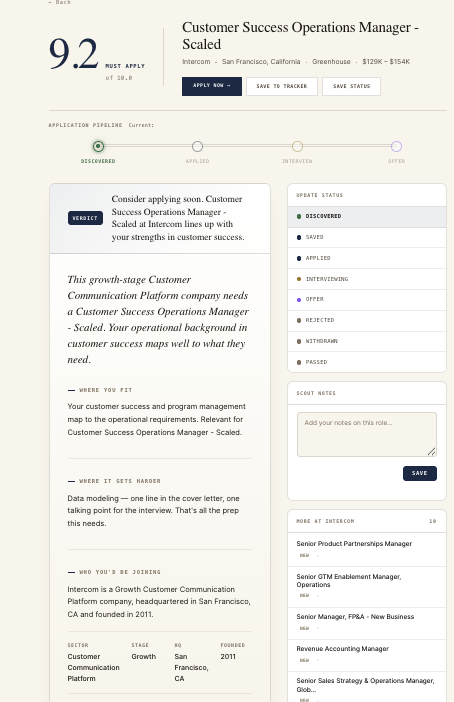
Click in and the scouting report deepens the same posture. Verdict, italic lede, three editorial sections: where you fit, where it gets harder, who you’d be joining. At the bottom, a receipts row with compensation, location, posted date, sector, stage, HQ, founded. The things you actually want to know before clicking through.
Names gaps, not just fits
The middle section is the one most matching tools won’t write. We will:
“Data modeling — one line in the cover letter, one talking point for the interview. That’s all the prep this needs.”
One specific gap. Named concretely, not as a vague “skills gap” hedge. Scoped to what closing it actually looks like: a sentence in the cover letter, a thirty-second answer at the interview. No instruction. No punishment. No “you should learn this before applying.”
If a posting wants production experience your resume doesn’t show, the report says so. If a credential the listing mentions reads more like a preference than a hard requirement, the report says that too. The hedges in the original posting are respected. The gaps aren’t hidden, but they’re also not weaponized.
A scouting report that only delivers good news isn’t a scouting report. It’s a sales pitch dressed up as one.
What the rebuild was actually about
When I read the first batch of reports after launch, the thing that bothered me wasn’t that they were wrong. It was that they were reading my keywords back at me. The reports knew what was on the resume; they didn’t know who the person was.
The rebuild was an attempt to fix that. More context on the company side, so the system has more to argue from. A voice that observes rather than instructs, so the report sounds like a person who looked at your work and noticed something. A receipts row that puts the facts you actually need to decide on a single page. Honest gaps, scoped proportionately.
That’s what I wanted these to feel like. Read your own scouting report. Check out our beta at role-radar.com.